Urban IoT
Sensors that end up as scheduled work, not as another dashboard.
A sensor network is only worth its maintenance cost if a reading can become a work order without a person watching a screen. Urban IoT keeps a registry of every device, stores its readings, applies the rules the city sets, and generates the intervention automatically when a threshold or a fault condition is met.
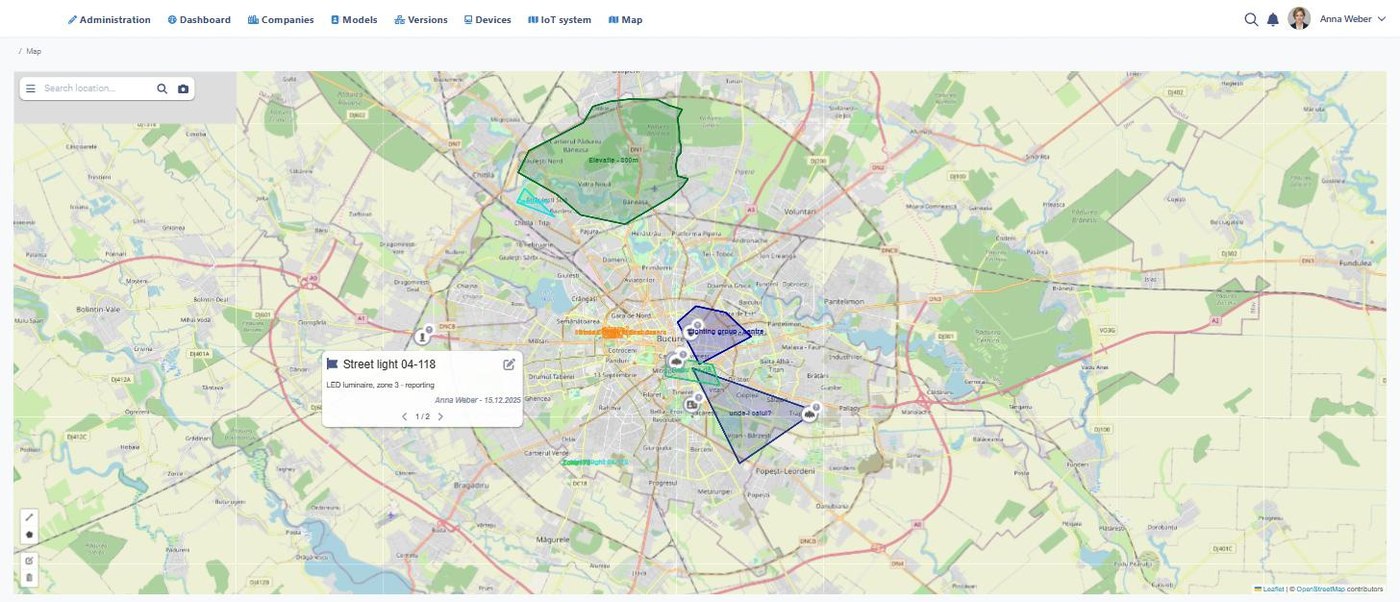
The device map: each asset with its last reading, its connectivity and its open events.
What changes
Collection on need, not on rota
Bins, tanks and meters are emptied or serviced when the reading says so, instead of on a fixed calendar.
Faults found before complaints
A device that stops reporting or reports out of range raises an event, so the failure is known before a resident calls.
Verified interventions
The work order carries the reading that triggered it and the reading after the fix, which is the proof the job was effective.
Key capabilities
Device registry
Every device with its location, type, owner, installation date and warranty, tied to the asset record.
Connectivity
LoRaWAN, NB-IoT, cellular and wired gateways, with the connection state visible per device.
Readings
Time series stored per device and per measurement, retained for trend and for evidence.
Rules and events
Thresholds, rates of change and missing-data conditions that raise an event when they are met.
Work generation
An event becomes a work order on the crew that owns that asset class, with the reading attached.
Device health
Battery, signal and last-seen, so a silent sensor is a known problem rather than a blank spot.
How it works
Register the device
The device is recorded against the asset and the location it serves.
Collect and store
Readings arrive through the gateway and are kept as a time series against that device.
Apply the rules
Thresholds and fault conditions are evaluated as the data arrives.
Act and close the loop
The event becomes a work order; the reading after the intervention closes it.
Watch the devices themselves
Battery, signal and silence are monitored like any other asset condition.
Urban IoT works with the systems your city already runs.
LoRaWAN and NB-IoT gateways, MQTT brokers, SCADA and telemetry, GIS and asset registries, work order management, analytics and reporting.
Related solutions
Smart Lighting
Luminaires as connected assets with schedules, faults and energy data.
Learn more →Environmental Monitoring
Air, noise and water measurements with a defined response.
Learn more →Public Asset Management
The asset register the devices are attached to.
Learn more →See a reading become a work order
We will register a device, push a reading past its threshold and follow the intervention it generates.