
Public Asset Management
One register for land, buildings, fleet and equipment, kept current by the work performed on them.
Ownership documents, valuation, condition and full service history on every city-owned asset, so capital planning, disposals and audits are built from the record rather than from a periodic inventory.
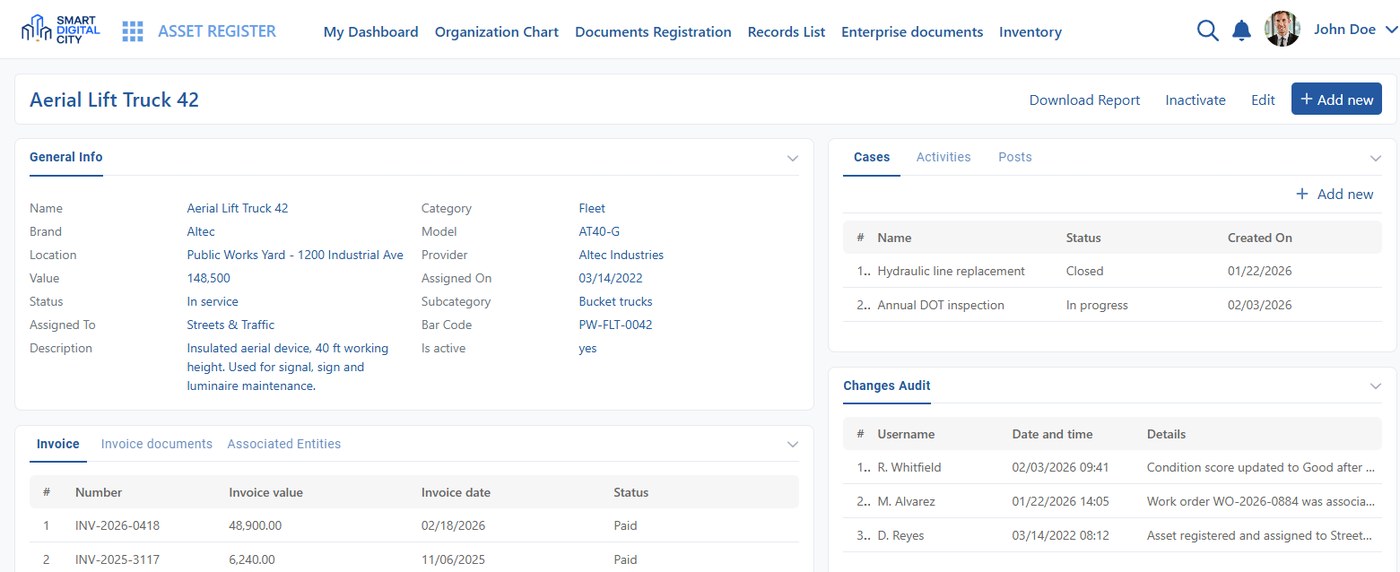
Asset record: identity, custody and value on the left, the cases and the change history on the right.
What changes
A register that stays current
Inspections, work orders and invoices post back to the asset, so condition and cost reflect this month rather than the last inventory exercise.
Whole-life cost on one record
Acquisition, maintenance, downtime and disposal sit against the same asset, so repair or replace is a calculation.
Decisions you can defend
Every transfer, disposal and capital request carries the condition history and the documents behind it.
Key capabilities
Land and buildings
Parcels, structures and their legal status, linked to the parcel record and to the documents that prove what the city holds.
Fleet and equipment
Serial numbers, warranties, service intervals and the department currently holding each item.
Valuation and depreciation
Acquisition cost, revaluation and depreciation in the accounting classification your finance office already uses.
Condition scoring
Condition derived from inspections and completed work, comparable across the whole portfolio.
Documents and obligations
Deeds, leases, easements and concessions, with the obligations and renewal dates attached to each.
Service history
Every job, cost and incident retained for the life of the asset and available at audit.
How it works
Register
Each asset receives a stable identifier, a location and the documents that establish what the city owns.
Classify
Asset classes carry their own required attributes, labelling scheme, valuation rules and inspection cycle.
Let the work feed it
Work orders, inspections and payments post back automatically, so the register needs no separate upkeep.
Score condition
Inspection results and job history produce a condition picture that can be ranked across the portfolio.
Plan from it
Maintenance programs, disposals and capital requests are built from the register rather than beside it.
Public Asset Management works with the systems your city already runs.
GIS · ERP · Finance · Procurement · Work Orders · IoT · REST API
Related solutions
Capital Projects
Plan and track the projects that create, renew or replace the assets in the register.
Learn more →Work Orders & Field Service
The field work that keeps the register current and the condition scores honest.
Learn more →Facilities Management
Day-to-day operation of the buildings and sites the register holds.
Learn more →Know what the city owns, and what it costs
See how Smart Digital City keeps a public asset register current from the work your crews already do.